EU CBAM 2026 at a glance
The EU Carbon Border Adjustment Mechanism entered its definitive regime on 1 January 2026. Importers above the 50-tonne annual threshold must now manage authorisation, customs data, embedded-emissions calculations and the financial exposure created by CBAM certificates. The first declaration and certificate surrender for 2026 imports are due on 30 September 2027, but the evidence behind that filing must be built during 2026.
The central operational point is simple: CBAM liability follows the importer, the product code, the country of origin and the emissions embedded in the goods. A customs entry alone is not enough. Importers need a controlled data trail from the declaration through to the supplier installation and, where actual emissions are used, an accredited verifier.
- CBAM applies to selected goods in cement, iron and steel, aluminium, fertilisers, electricity and hydrogen.
- The 50-tonne exemption aggregates net mass across cement, iron and steel, aluminium and fertilisers per importer and calendar year. It does not apply to electricity or hydrogen.
- Once an importer exceeds the threshold, CBAM obligations apply to all in-scope goods imported during that calendar year, including the tonnes imported before the threshold was crossed.
- Actual emissions used in the annual declaration must be verified by an accredited CBAM verifier. Default values remain available under the definitive rules but can create a higher or simply different exposure.
- Certificates for 2026 emissions can be purchased from 1 February 2027. The first declaration and surrender deadline is 30 September 2027.
- The Commission corrected the definitive-period default-value tables in July and August 2026. Cost models must use the corrected dataset for the whole of 2026.
What changed on 1 January 2026
During the transitional period, importers reported embedded emissions without buying CBAM certificates. The definitive regime turns that reporting exercise into an enforceable carbon-pricing system. The authorised CBAM declarant records the relevant imports, submits an annual CBAM declaration and surrenders certificates corresponding to the reportable embedded emissions after the permitted adjustments.
The number of certificates is not calculated by multiplying import weight by an EU ETS price alone. The declaration must account for the embedded emissions of each type of good, any eligible carbon price effectively paid in the country of production, and the adjustment that reflects free allocation under the EU ETS. The definitive calculation and free-allocation rules are set out in separate implementing regulations, so finance models should preserve these components rather than collapse them into one opaque rate.
Which imports fall within EU CBAM in 2026
CBAM scope is determined by the Combined Nomenclature and, in some cases, TARIC code listed in Annex I to the CBAM Regulation. The six headline sectors are useful for orientation, but they are not a substitute for code-level classification. A steel-containing product is not automatically covered, while a product that looks finished may still sit under an in-scope code.
| Sector | Typical in-scope goods | Threshold treatment |
|---|---|---|
| Çimento | Clinker, cement and calcined clay under listed codes | Included in the cumulative 50-tonne test |
| Demir ve çelik | Iron ores, ferro-alloys, primary steel and listed downstream articles | Included in the cumulative 50-tonne test |
| Aluminium | Unwrought aluminium and listed semi-finished or finished goods | Included in the cumulative 50-tonne test |
| Fertilisers | Ammonia, nitric acid and listed nitrogenous fertilisers | Included in the cumulative 50-tonne test |
| Üretilen mallarla ilgili elektrik tüketimi (kWh cinsinden), | Imported electricity | No 50-tonne exemption |
| Hidrojen | Imported hydrogen | No 50-tonne exemption |
Classification should be owned jointly by customs and the CBAM team, recording the code used, the product description, country of origin, importer of record, net mass and customs declaration reference.
How the 50-tonne threshold works
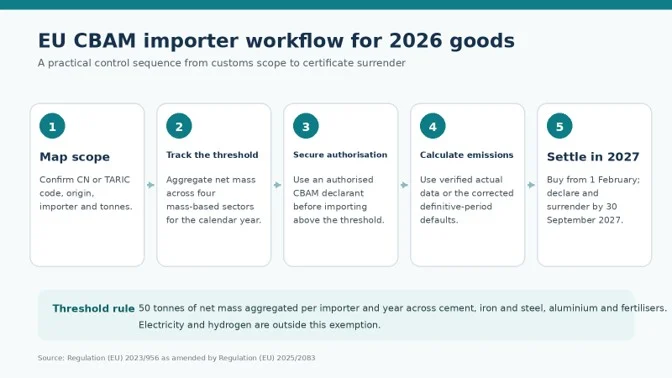
The de minimis exemption is annual and importer-specific. The net mass of covered goods is aggregated across all relevant CN codes in the four mass-based sectors. It is not a 50-tonne allowance for each sector, supplier, shipment or Member State.
An importer that remains at or below 50 tonnes during the calendar year is exempt from the CBAM obligations covered by the rule and declares the exemption in the relevant customs declaration. If the importer exceeds the threshold, all embedded emissions in all in-scope goods imported during that calendar year become subject to the Regulation.
A business forecasting 45 tonnes should therefore monitor purchase orders and customs clearances closely; one additional shipment can change the treatment of the entire year.
Electricity and hydrogen are excluded from the mass-based exemption. Non-EU importers also need to consider the role of an indirect customs representative under the authorisation rules.
Authorised CBAM declarant and customs readiness
An EU importer that expects to exceed the threshold should apply for authorised CBAM declarant status before importing above it. An indirect customs representative can act as the authorised declarant where the legal conditions are met. For an importer not established in an EU Member State, the indirect customs representative must obtain the status.
The temporary route for businesses that applied by 31 March 2026 allows them to continue importing while the national competent authority decides the application. That date has passed. A company planning new in-scope imports should not assume that submitting an application now creates the same provisional right.
Operationally, the authorisation workstream should cover the EORI number, responsible entity, tax and customs standing, financial and operational capacity, forecast import quantities and the people who can access the CBAM Registry. Customs brokers need the correct declarant details before clearance, and the importer should reconcile broker data to its own CBAM ledger at least monthly.
How to calculate embedded emissions
The definitive regime allows two broad data routes for goods other than electricity. Importers can use actual embedded emissions calculated under the definitive-period methodology, or the applicable default values where the Regulation permits. Actual data provides an installation-specific result, but it must follow the EU method and be verified before it supports the annual declaration.
Default data is not a single sector average. The definitive tables combine country and product information, and they can require a fallback to the ‘Other countries and territories’ table. For 2026, the total default value is increased by 10% for cement, iron and steel, aluminium and hydrogen, and by 1% for fertilisers. The production-route indicator can also affect the free-allocation adjustment.
The Commission’s July correcting regulation replaced Annexes I and IV and applies from 1 January 2026. Importers should use the corrected values published in August, even for goods imported earlier in the year. A cost model based on the original December 2025 tables may materially overstate or understate exposure for specific country-code combinations.
How CBAM certificates affect cash flow
CBAM certificate prices mirror EU ETS auction prices. For goods imported during 2026, the Commission calculates four quarterly prices and applies the price for the quarter of importation. The published price was €75.36 for the first quarter and €75.28 for the second quarter. The third-quarter price is scheduled for publication on 5 October 2026 and the fourth-quarter price on 4 January 2027.
Certificate sales begin on 1 February 2027. Authorised declarants must submit the 2026 declaration and surrender the corresponding certificates by 30 September 2027. Building a controlled import workflow now avoids a scramble later.
Finance teams should therefore distinguish three dates: the import date that fixes the applicable 2026 quarterly price, the cash purchase date from February 2027, and the 30 September 2027 surrender deadline. A 2026 import creates an exposure even though the cash purchase happens later.
The importer workflow for 2026
| Control | Owner | Required action | Evidence to retain |
|---|---|---|---|
| Scope | Customs and trade compliance | Map in-scope CN or TARIC codes and origins | Classification rationale and customs entries |
| Threshold | Trade compliance and finance | Aggregate net mass per importer and forecast year-end volume | Monthly threshold dashboard and purchase-order forecast |
| Authorisation | Legal and customs | Confirm authorised declarant status and Registry access | Decision, application record, EORI and user roles |
| Supplier data | Procurement and sustainability | Collect installation, process, precursor and emissions data | Supplier submissions, monitoring plan and change log |
| Doğrulama | Sustainability and supplier | Book accredited verification for actual data | Verification report and corrected findings |
| Cost | Finans | Apply quarterly price, free-allocation adjustment and carbon-price credit | Versioned model tied to customs and emissions records |
| Declaration | Authorised declarant | Reconcile, submit and surrender by 30 September 2027 | Registry submission, reconciliation and certificate record |
Key dates for 2026 imports
| Date | What happens | Importer implication |
|---|---|---|
| 1 January 2026 | Definitive regime applies | Start the annual import and emissions evidence trail |
| 3 August 2026 | Default-value correction enters into force and applies from 1 January | Replace the original definitive tables in 2026 models |
| September 2026 onward | Verifier registration and first verification work begins | Reserve capacity and close supplier data gaps |
| 31 December 2026 | First definitive-regime reporting year closes | Freeze the customs population and complete year-end reconciliation |
| 1 February 2027 | Certificate sales begin | Fund and purchase certificates for 2026 exposure |
| 30 September 2027 | First declaration and surrender deadline | Submit the 2026 declaration and surrender the required certificates |
| 31 October 2027 | Repurchase request deadline after surrender | Request repurchase of eligible excess certificates if applicable |
Common CBAM mistakes in the definitive regime
- Treating 50 tonnes as a per-shipment or per-sector threshold instead of an annual aggregate per importer.
- Counting only imports after the threshold is crossed. Once exceeded, the rule reaches all in-scope imports for that calendar year.
- Using a sector label instead of validating the exact CN or TARIC code and country of origin.
- Reusing transitional-period supplier calculations without checking the definitive-period methodology and verification requirements.
- Loading the original December 2025 default-value tables and missing the correction that applies retroactively to 1 January 2026.
- Forecasting cost from emissions times the EU ETS price while omitting the default-value mark-up, free-allocation adjustment or eligible carbon price paid abroad.
- Leaving verification until mid-2027, when supplier corrections and verifier capacity may become harder to secure.
A 30 day action plan for importers
- Reconcile 2026 customs data by importer, CN or TARIC code, origin and net mass.
- Calculate the current threshold position and a year-end forecast that includes open purchase orders.
- Confirm authorised declarant status, Registry users and the instructions held by customs brokers.
- Segment suppliers by expected CBAM exposure and decide where verified actual data is commercially valuable.
- Reload the corrected default-value dataset and preserve its source version in the cost model.
- Build a quarterly price view for 2026 and keep free allocation and foreign carbon-price deductions as separate model fields.
- Agree an evidence owner and verification timetable for every installation from which actual emissions will be claimed.
Frequently asked questions
Is EU CBAM already active in 2026?
Yes. The definitive regime applies from 1 January 2026. Certificate purchases for 2026 emissions begin on 1 February 2027, and the first declaration and surrender deadline is 30 September 2027.
Who must comply with the 50-tonne CBAM threshold?
The threshold is assessed per importer and calendar year across the net mass of in-scope cement, iron and steel, aluminium and fertiliser goods. Electricity and hydrogen do not benefit from the exemption.
What happens if an importer exceeds 50 tonnes late in the year?
The obligations apply to all embedded emissions in all in-scope goods imported by that importer during the calendar year, including imports made before the threshold was crossed.
Can an importer use CBAM default values in 2026?
Yes, where the definitive rules allow them. Use the corrected country and product tables, apply the required 2026 mark-up to total emissions, and apply the correct fallback and production-route logic.
Do actual CBAM emissions need verification?
Yes. When the annual declaration relies on actual emissions, the data must be verified by an independent verifier accredited by an EU national accreditation body.
When are CBAM certificates purchased and surrendered?
Sales start on 1 February 2027. Certificates for 2026 imports must be available and surrendered with the first annual declaration by 30 September 2027.
Can a customs representative manage CBAM for an importer?
An indirect customs representative can act as the authorised CBAM declarant when it accepts that role and meets the authorisation rules. Responsibility and data access should be agreed explicitly.
Official sources
- European Commission CBAM definitive regime — scope, threshold, sectors, certificate price cadence and annual obligations
- Consolidated Regulation (EU) 2023/956 — Articles 2a, 4 to 9 and 20 to 23 as amended by Regulation (EU) 2025/2083
- European Commission CBAM certificate prices — 2026 quarterly price methodology and published Q1 and Q2 prices
- European Commission CBAM verification — verification actors, accreditation and 2026 to 2027 timeline
- European Commission legislation and guidance — definitive-period implementing acts and corrected default values
Build a reliable 2026 CBAM baseline
Climease helps importers connect customs data, supplier emissions, verification status and certificate-cost forecasting in one workflow. Estimate your 2026 CBAM exposure or speak with the Climease team about a controlled path from import records to the annual declaration.
This article provides general information and does not constitute legal, customs or tax advice. Businesses should confirm the treatment of their products and circumstances with their advisers and national competent authority.
Bültenimize Abone Olun