


Most importers we speak to answer the verifier question with a brand name. “Our supplier is working with one of the big inspection firms, so we are fine.” That answer can hide three problems: the firm may not hold CBAM accreditation yet, its accreditation may not cover the right sector, and the accredited entity may not be able to reach the installation that makes your goods.
The verifier is the gate between your supplier’s emissions data and your declaration. Choosing well is now a procurement decision with a deadline: the 2026 declaration is due by 30 September 2027, and every installation needs a physical site visit for the 2026 reporting period.
Answer capsule
Select a CBAM verifier by checking accreditation status, sector scope, the accredited legal entity or office, installation coverage, country reach, capacity, evidence requirements and Registry readiness. A familiar global brand is not enough if the accredited entity cannot cover the relevant installations.
This guide is written for both sides: importers who want to check the verifier their supplier has chosen, and non-EU operators who are appointing one. For the rules behind verification, see our CBAM verification guide.
The 10 questions at a glance
| # | Question to ask | What a good answer looks like |
|---|---|---|
| 1 | Are you accredited for CBAM, and can you show the certificate? | A CBAM accreditation certificate from an EU or EEA national accreditation body, with number and validity dates |
| 2 | Which activity groups does your accreditation cover? | The scope lists the sector and goods of the installation: steel, aluminium, cement, fertilisers, hydrogen or electricity |
| 3 | Which legal entity is accredited, and by which NAB? | The entity that will sign the report is the one named on the certificate |
| 4 | Can you work in the installation’s country? | Auditors who can travel there, speak the language or work with interpreters, and handle local documents |
| 5 | When can you do the 2026 site visit? | A proposed date, not a general promise |
| 6 | Can you cover precursor installations if needed? | A plan for precursors made at the same site or bought from other plants |
| 7 | How many CBAM verifications can you deliver before mid-2027? | A realistic view of capacity and lead auditors for your sector |
| 8 | What evidence will you ask for? | A document request list tied to the monitoring methodology, sent before the visit |
| 9 | What is the timeline from contract to report? | Dates for planning, site visit, findings and report, with time to correct misstatements |
| 10 | Are you registered in the CBAM Registry, and how will you submit the report? | Registered as an accredited verifier in O3CI, ready to accept a collaboration request from the operator |
Accreditation: questions 1 to 3
1. Accreditation status. Only a verifier accredited for CBAM by a national accreditation body (NAB) of an EU or EEA country can verify embedded emissions for the definitive period. Accreditation for the EU ETS, ISO 14064 or product carbon footprints is not the same thing. Ask for the CBAM accreditation certificate, and check it against the Commission’s official list of accredited verifiers once it is published on the CBAM verification page. The Commission updated its state-of-play table on accreditation on 7 October 2026.
2. Scope and sectors. CBAM accreditation is granted for defined activity groups under Delegated Regulation (EU) 2025/2551. A verifier accredited for one sector is not automatically accredited for another. Match the scope on the certificate to what the installation actually produces, and to its production route.
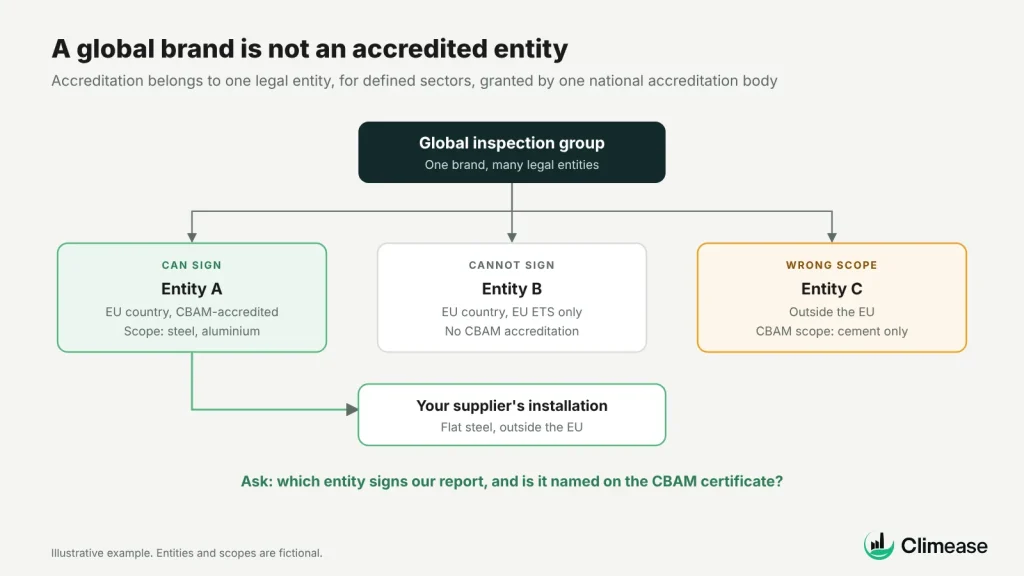
3. The accredited entity and its NAB. Large inspection groups operate through many legal entities. Accreditation belongs to a specific entity, granted by a specific NAB. Verifiers established in the EU or EEA apply to the NAB of their own country; verifiers established outside the EU can apply to any NAB that offers CBAM accreditation. The question to ask is simple: which entity will sign our report, and is that entity on the certificate?
Coverage: questions 4 to 6
4. Country reach. Most CBAM installations are outside the EU. The verifier needs people who can get to the site, read local records and work with the operator’s team. An accredited entity in Europe may cover a plant in India or Türkiye through its own auditors or through qualified staff elsewhere in the group, but ask how this works in practice.
5. Site visits. For the 2026 reporting period every installation needs a physical site visit. From 2027, a visit can be virtual or waived in low-risk cases, with a physical visit at least every two years. Ask for a proposed visit date now. Site visits cluster in the first half of 2027, and late requests will compete for the same auditors.
6. Precursor coverage. Many CBAM goods carry precursor emissions, from pig iron and crude steel to unwrought aluminium. If precursors are made at the same site, the verifier covers them in the same visit. If they come from other installations, those need their own verified data, or they fall back to default values. Ask the verifier how it handles both cases. Our precursor guide explains why this matters for cost.
Delivery: questions 7 to 10
7. Capacity. Accreditation started in 2026 and the number of accredited verifiers is still growing. A verifier that is accredited but fully booked does not help you. Ask how many CBAM engagements it can complete before mid-2027, and who the lead auditor for your sector will be.
8. Evidence expectations. A good verifier tells the operator early what it will look at: the monitoring methodology documentation, meter and calibration records, fuel and material data, production by CN code, precursor data and the controls around them. If the operator has prepared a CBAM monitoring plan, the evidence request should map onto it.
9. Timeline. Work backwards from your declaration. Leave time for findings and corrections: misstatements above the 5% materiality level must be corrected before the verifier can issue a positive opinion.
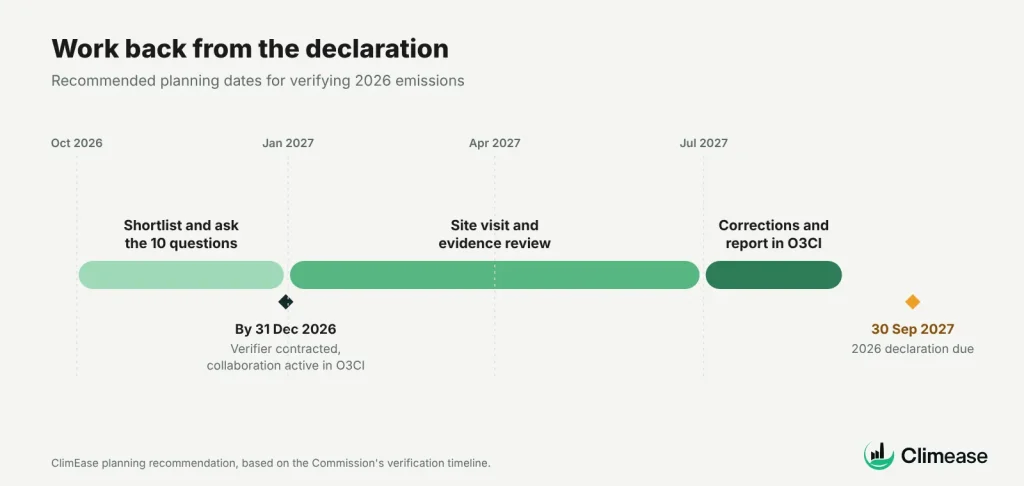
10. Registry readiness. Verification reports reach declarants through the CBAM Registry. The verifier must be registered as an accredited verifier in the O3CI portal, which is a separate step from accreditation, and the operator must accept a collaboration request with that verifier. Only one verifier can have an active collaboration with an installation at a time. Our Registry and O3CI guide walks through each step.
Red flags
- The verifier cannot show a CBAM accreditation certificate, only an EU ETS or ISO accreditation.
- The scope on the certificate does not mention the installation’s sector.
- The entity signing the contract is not the entity named on the certificate.
- No site visit date is offered, or the visit is proposed after mid-2027.
- No evidence request list is shared before the visit.
- The verifier is not registered in the CBAM Registry, or has no administrator able to accept collaboration requests.
- The verifier also helped build the operator’s emissions calculation. Verifiers must be independent of the installations they verify.
Verifier selection scorecard
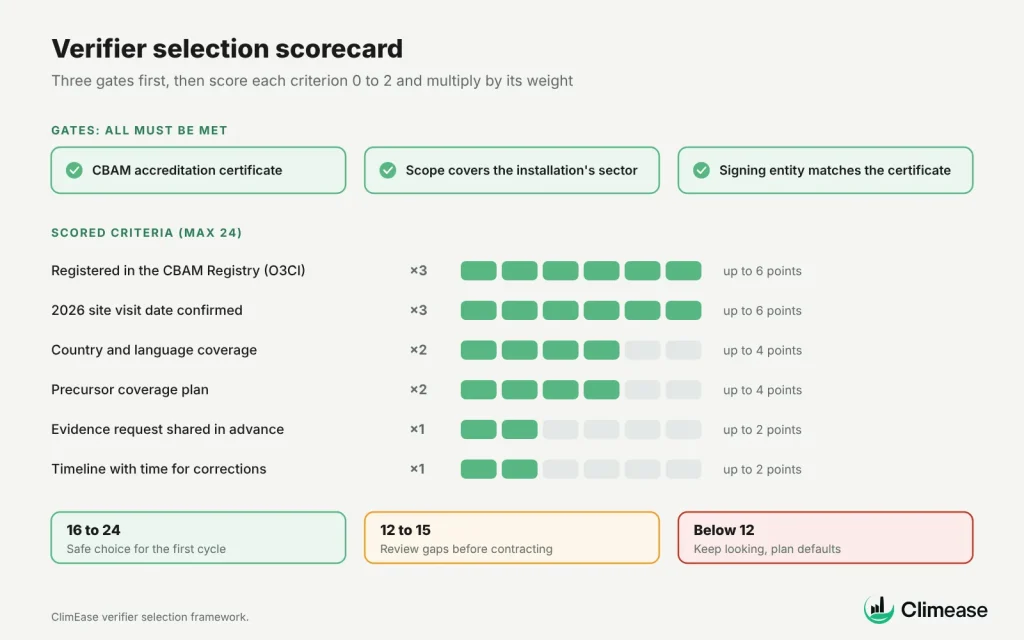
Use this to compare two or three candidates for the same installation. Score each criterion from 0 to 2 and multiply by the weight. Gates must be met before scoring starts.
| Criterion | Type | Weight | 0 points | 2 points |
|---|---|---|---|---|
| CBAM accreditation certificate | Gate | Must have | Not shown | Shown and valid |
| Scope covers the installation’s sector | Gate | Must have | Not covered | Covered |
| Signing entity matches the certificate | Gate | Must have | Different entity | Same entity |
| Registered in the CBAM Registry (O3CI) | Score | ×3 | Not started | Registered |
| 2026 site visit date | Score | ×3 | None offered | Date confirmed before Q2 2027 |
| Country and language coverage | Score | ×2 | Unclear | Local team or proven approach |
| Precursor coverage plan | Score | ×2 | No plan | Clear plan for on-site and bought-in precursors |
| Evidence request shared in advance | Score | ×1 | None | Detailed list |
| Timeline with time for corrections | Score | ×1 | No dates | Dated plan |
A verifier that passes the gates and scores 16 or more out of 24 is usually a safe choice for the first cycle. Below 12, keep looking or plan for default values as a fallback.
The bottom line
A trusted name is a good start, not a selection method. Check that the right entity holds CBAM accreditation for the right sector, that it can reach the installation and its precursors, that it has capacity for a 2026 site visit, and that it is registered in the CBAM Registry. Ten questions now save a default-value declaration in September 2027.
Want help checking your suppliers’ verifiers? ClimEase’s team of former verifiers reviews verifier choices, prepares operators for the site visit and tracks verification status for every installation in your portfolio. Book a 30-minute call and bring your top suppliers.
Related reading: CBAM verification in 2026 · Actual vs default emissions under CBAM · CBAM emission calculation explained for suppliers
Sources: European Commission: Verification of CBAM emissions · European Commission: CBAM Registry
Abonnieren Sie unseren Newsletter