


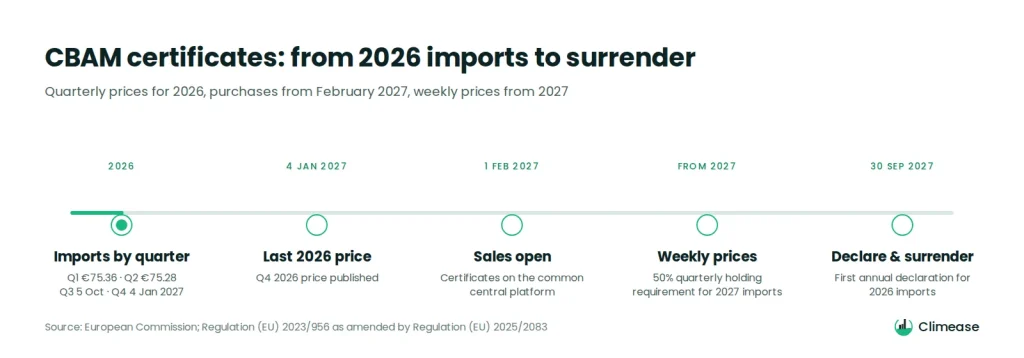
The European Commission publishes four CBAM certificate prices for 2026, one per quarter, based on the weighted average of EU ETS allowance auction clearing prices. The Q1 2026 price is €75.36 and the Q2 2026 price is €75.28. The Q3 price is scheduled for 5 October 2026 and the Q4 price for 4 January 2027. Each price applies to certificates corresponding to goods imported in that quarter. Certificates can be bought on the common central platform from 1 February 2027, and certificates for 2026 imports must be surrendered by 30 September 2027.
Official CBAM certificate prices for 2026
| Quarter | Applies to goods imported | Publication date | Price per certificate |
|---|---|---|---|
| Q1 2026 | 1 January – 31 March 2026 | 7 April 2026 | €75.36 |
| Q2 2026 | 1 April – 30 June 2026 | 6 July 2026 | €75.28 |
| Q3 2026 | 1 July – 30 September 2026 | 5 October 2026 (scheduled) | To be published |
| Q4 2026 | 1 October – 31 December 2026 | 4 January 2027 (scheduled) | To be published |
Source: European Commission, Price of CBAM certificates. One CBAM certificate corresponds to one tonne of CO2e of embedded emissions.
How the price is calculated
The CBAM certificate price mirrors the carbon price paid by EU producers under the EU ETS, so that imported and domestic goods face a comparable carbon cost. For 2026, the Commission calculates each quarterly price as the weighted average of the auction clearing prices of EU ETS allowances auctioned during the quarter. It does so in the first calendar week after the quarter ends, using publicly available auction data. The rules are set out in Article 21 of Regulation (EU) 2023/956, as amended by Regulation (EU) 2025/2083, and in Implementing Regulation (EU) 2025/2548.
Because the price is an average of auctions over three months, it moves more slowly than the daily EU ETS market. The first two quarters of 2026 differed by only 8 cents. That stability is useful for budgeting, but it does not mean the price is fixed for the year.
Matching the price to the quarter of importation
For 2026, the relevant price is the one for the quarter in which the goods were imported, not the date of purchase or surrender. A model that applies one annual price, or a live EU ETS spot price, will misstate the cost. In practice:
- Group customs data by the quarter in which the goods were released for free circulation.
- Apply the price published for that quarter to the certificates required for those goods.
- Until the Q3 and Q4 prices are published, use a clearly labelled estimate and replace it as soon as the official figure appears.
Estimating a quarter before the price is published
Finance teams often need a figure before the Commission publishes it, for example at the end of September for Q3 imports. A reasonable approach is to take the average of EU ETS auction clearing prices observed so far in the quarter, label it as a provisional estimate, and replace it with the official price in the first week of the following quarter. Keep the provisional and official figures side by side so the variance can be explained.
Price is only one input. For most importers, the choice between default values and verified supplier data, and the free allocation adjustment, move the final cost far more than the difference between two quarterly prices. The price table should feed the cost model, not replace it.
When and how certificates can be bought
Regulation (EU) 2025/2083 postponed the start of certificate sales. The timeline for 2026 imports is now:
| Date | What happens |
|---|---|
| 2026 | Imports create the obligation. No certificates can be bought yet, and no quarterly holding requirement applies to 2026 imports. |
| From 1 February 2027 | Member States sell CBAM certificates to authorised declarants established in their territory on the common central platform. |
| By 30 September 2027 | Authorised declarants submit the first annual CBAM declaration for 2026 and surrender the corresponding certificates via the CBAM Registry. |
| During 2027 | Certificates bought in 2027 for 2026 emissions can only be repurchased in 2027. |
Buying earlier does not lock in a lower price for 2026 imports: the price is tied to the quarter of importation. The practical questions are cash-flow timing and making sure the declarant’s registry account and authorisation are ready before February 2027.
What changes in 2027
- Weekly prices: from 2027 the certificate price becomes a weekly average of EU ETS auction prices, instead of a quarterly one.
- Quarterly holding requirement: from 2027, at the end of each quarter the declarant must hold certificates covering at least 50% of the embedded emissions in goods imported since the start of the year, on a cumulative basis.
- Repurchase limits: repurchase is limited to the number of certificates the declarant had to buy under the quarterly requirement during the calendar year of purchase.
- Default carbon prices: from 2027, the Commission may publish yearly default carbon prices for third countries with carbon pricing rules. The default is an alternative, not an obligation: where embedded emissions are based on actual emissions, the declarant can still claim the carbon price effectively paid, provided the payment is documented and the documentation is certified by an independent person (Article 9 of Regulation (EU) 2023/956).
The move to weekly prices and a quarterly holding requirement turns certificate purchasing into a recurring treasury activity rather than a single annual payment. Treasury, finance and the declarant’s compliance team will need an agreed purchasing rhythm, a forecast of embedded emissions by quarter and a clear owner for registry transactions well before the first quarter-end check in 2027.
Frequently asked questions
What is the CBAM certificate price for 2026?
The Commission has published €75.36 for Q1 2026 and €75.28 for Q2 2026. Q3 is scheduled for 5 October 2026 and Q4 for 4 January 2027.
How is the CBAM certificate price calculated?
For 2026, as the weighted average of the auction clearing prices of EU ETS allowances in each quarter, calculated in the first calendar week after the quarter ends.
Which price applies to my imports?
The price for the quarter in which the goods were imported.
When can CBAM certificates be bought?
From 1 February 2027, on the common central platform, by authorised CBAM declarants.
When must certificates for 2026 imports be surrendered?
By 30 September 2027, together with the first annual CBAM declaration.
Will the price be weekly in 2027?
Yes. From 2027 the Commission will publish weekly CBAM certificate prices based on EU ETS auction prices.
Stay on top of CBAM prices
Climease updates certificate prices in its cost models as soon as the Commission publishes them, so importers can see how each quarter changes their exposure.
Subscribe to Climease certificate-price updates or run a 2026 CBAM cost estimate.
This article provides general information and does not constitute legal, tax or financial advice.
Official sources
- Price of CBAM certificates — official prices, publication dates and methodology
- CBAM legislation and guidance — Implementing Regulation (EU) 2025/2548
- Regulation (EU) 2025/2083 — Articles 20 to 23: sales from 1 February 2027, surrender, holding and repurchase
Subscribe to our Newsletter