


The European Commission corrected the definitive-period CBAM default values through Implementing Regulation (EU) 2026/1740. The act was published on 31 July 2026, entered into force on 3 August and applies from 1 January 2026. The Commission then posted an information-only Excel workbook on 10 August. Importers that used the original tables must recalculate the full 2026 period, not only imports made after the correction.
The correction is broader than a short list of changed emission factors. It replaces Annexes I and IV, removes the pre-calculated columns that included future mark-ups, adds or corrects production-route indicators, clarifies units and fallback logic, and fixes selected country-code values. Some cost estimates fall sharply; others increase.
The August correction in brief
The European Commission corrected the definitive-period CBAM default values through Implementing Regulation (EU) 2026/1740. The act was published on 31 July 2026, entered into force on 3 August and applies from 1 January 2026. The Commission then posted an information-only Excel workbook on 10 August. Importers that used the original tables must recalculate the full 2026 period, not only imports made after the correction.
The correction is broader than a short list of changed emission factors. It replaces Annexes I and IV, removes the pre-calculated columns that included future mark-ups, adds or corrects production-route indicators, clarifies units and fallback logic, and fixes selected country-code values. Some cost estimates fall sharply; others increase.
- Implementing Regulation (EU) 2026/1740 replaces Annexes I and IV to Implementing Regulation (EU) 2025/2621.
- The corrected annexes apply retroactively from 1 January 2026.
- Models must select the base value from the total-emissions column and then calculate the mark-up: 10% in 2026 for cement, iron and steel, aluminium and hydrogen, and 1% for fertilisers.
- A blank or dash in a listed country row generally sends the model to the corresponding ‘Other countries and territories’ value.
- Production-route indicators affect the free-allocation adjustment even where the base emissions value itself does not change.
- The Commission’s Excel workbook is useful for implementation, but the legal values are the values in the regulation and its correcting act.
What was corrected and when
| Date | Regulatory event | Cost model implication |
|---|---|---|
| 31 December 2025 | Original Implementing Regulation (EU) 2025/2621 published | Many teams loaded the first definitive-period tables |
| 31 July 2026 | Implementing Regulation (EU) 2026/1740 published | Annexes I and IV are replaced in full |
| 3 August 2026 | Correcting act enters into force | Use the corrected annexes, applying from 1 January 2026 |
| 10 August 2026 | Commission posts corrected Excel workbook | Reload the implementation dataset and retain source version |
| 15 September 2026 | Current model review date | Reconcile year-to-date imports against the corrected dataset |
The regulation explains that several problems arose from transcription and consolidation errors. Rather than publish isolated edits, the Commission replaced the full annexes. That approach reduces the risk of missing an amendment but makes version control essential: a row copied from the original regulation can still look plausible even when it is no longer the applicable row.
Which parts of the dataset changed
| Correction type | Official example | Why it matters to a model |
|---|---|---|
| Country and code values | Taiwan CN codes 7218 to 7223 and ‘Other countries and territories’ CN 7226 20 00 | Changes the base total emissions and therefore the gross certificate exposure |
| Previously omitted values | Gabon and Liberia hydrogen; Guatemala and New Caledonia ferro-nickel; selected Albania, Zambia and Zimbabwe ferro-alloys | Replaces the fallback value where the new country-specific row differs |
| Production routes | Missing or incorrect indicators in Annexes I and IV | Changes which CBAM benchmark supports the free-allocation adjustment |
| Mark-up presentation | Pre-calculated 2026, 2027 and 2028 columns removed | The model must calculate the mark-up from the base total, avoiding table-rounding inconsistencies |
| TARIC detail | White and grey clinker or hydraulic cement; calcined kaolinic clay | Prevents the wrong value being applied to products sharing a broader CN heading |
| Units and naming | Units specified and country naming aligned | Improves data validation and mapping to customs master data |
| Unknown-country precursors | CN 7616 99 10 and 7616 99 90 | Corrects the high default used when precursor origin cannot be identified |
How to calculate a 2026 default value
The corrected Annex I tells the importer to select the total-emissions default and apply the mark-up separately. For cement, iron and steel, aluminium and hydrogen, the 2026 marked-up default equals the base total multiplied by 1.10. For fertilisers, multiply by 1.01. Direct and indirect columns are provided for information; the total-emissions column drives the default used to calculate the number of certificates.
A transparent forecast keeps the calculation in three layers. First, multiply imported tonnes by the corrected marked-up total to calculate embedded emissions under the default route. Second, calculate the free-allocation adjustment under Implementing Regulation (EU) 2025/2620 and deduct any eligible carbon price effectively paid in the country of production. Third, value the remaining certificate requirement at the 2026 quarterly CBAM price that corresponds to the quarter of importation.
| Model layer | Calculation | Control |
|---|---|---|
| Default emissions | Tonnes imported × corrected total default × applicable mark-up | Country, code, fallback and dataset version |
| Certificate requirement | Default emissions less free-allocation adjustment and eligible carbon-price reduction | Production route, benchmark and evidence of price paid |
| Financial exposure | Certificates required × quarter-specific 2026 CBAM price | Quarter of importation and official published price |
Do not label the first layer as final CBAM liability. It is a gross carbon-price exposure used to isolate the impact of the corrected default values. The final certificate number depends on the free-allocation adjustment, carbon-price credit and the legal calculation applicable to the good.
Selected cost impacts at the Q2 2026 price
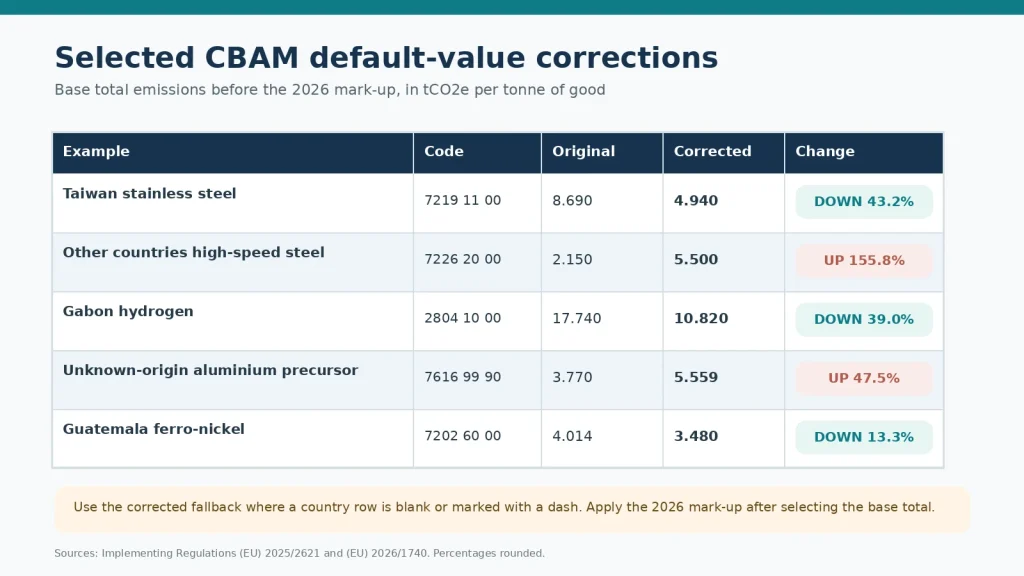
The following examples isolate the data change for 1,000 tonnes and use the Commission’s published Q2 2026 certificate price of €75.28. They apply the 10% default-value mark-up and show gross exposure before the free-allocation adjustment or any eligible carbon price paid abroad. Actual costs will also depend on the quarter of importation and the final certificate calculation.
| Country and good | Original base | Corrected base | Change | Original gross exposure | Corrected gross exposure |
|---|---|---|---|---|---|
| Taiwan stainless steel 7219 11 00 | 8.690 | 4.940 fallback | -43.2% | €719,602 | €409,072 |
| Other countries high-speed steel 7226 20 00 | 2.150 | 5.500 | +155.8% | €178,037 | €455,444 |
| Gabon hydrogen 2804 10 00 | 17.740 fallback | 10.820 | -39.0% | €1,469,014 | €895,983 |
| Unknown-origin aluminium precursor 7616 99 90 | 3.770 | 5.559 | +47.5% | €312,186 | €460,330 |
| Guatemala ferro-nickel 7202 60 00 | 4.014 fallback | 3.480 | -13.3% | €332,391 | €288,172 |
The Taiwan example also shows why fallback logic matters. The corrected country table contains dashes for the affected stainless-steel rows, so the model moves to the corresponding ‘Other countries and territories’ value. A model that treats the dash as zero would materially understate exposure, while a model that keeps the original Taiwan value would materially overstate it.
The ‘Other countries and territories’ correction for CN 7226 20 00 moves in the opposite direction. The base total rises from 2.150 to 5.500 tCO2e per tonne. For unknown-country aluminium precursors under CN 7616 99 90, the highest default rises from 3.770 to 5.559. These are precisely the cases where a version update can change procurement comparisons or provisions without any change in import volume.
Why production route corrections matter
A default emissions value feeds only part of the CBAM calculation. When a production route is attached to a product row, it identifies the relevant CBAM benchmark for the specific embedded free allocation. Missing or incorrect indicators can therefore change the free-allocation adjustment even if the total-emissions value stays the same.
The correcting regulation also clarifies that, where an HS-level group carries a production route but the benchmark for an eight-digit CN code has no route, the benchmark for that eight-digit code is independent of the route. Models should not automatically inherit a parent-code route without checking the legal row and benchmark mapping.
How to rebuild a 2026 CBAM cost model
Rebuilding the model is a controlled sequence, not a single find-and-replace of numbers.
- Archive the original dataset and identify every calculated field that referenced it. Do not overwrite the old source without a version record.
- Load the corrected Annex I and Annex IV values. Record the regulation number, workbook version date and ingestion timestamp.
- Normalize spaces and punctuation in CN and TARIC codes, but preserve leading zeros and the distinction between four-, six-, eight- and ten-digit codes.
- Apply the fallback rule explicitly. A listed country with a blank or dash normally points to the corresponding ‘Other countries and territories’ row; it does not mean zero emissions.
- Calculate the mark-up from the corrected base total. Do not import the removed pre-calculated columns or recreate them from rounded historical outputs.
- Map the corrected production-route indicator to the benchmark and free-allocation adjustment logic.
- Recalculate all 2026 imports from 1 January, grouped by quarter of importation so each quarter uses its official CBAM certificate price.
- Compare old and new outputs by country, code, supplier and purchase order. Route material movements to finance and procurement for review.
- Keep actual supplier data and default values as separate scenarios. A corrected default should not overwrite verified installation-specific emissions.
- Lock the new model version and add automated checks for missing codes, duplicate mappings, zero values, unexpected fallback rates and production-route changes.
Controls that prevent the next silent model error
- Dataset hash or source version stored with every calculation run.
- A fallback flag that shows why the ‘Other countries and territories’ row was used.
- A variance report that isolates changes in emissions factor, mark-up, benchmark, price and import volume.
- A quarterly price table sourced from the Commission rather than a live EU ETS spot-price feed.
- A review queue for newly introduced TARIC distinctions and codes that map to more than one product description.
- A supplier-level comparison between corrected defaults and verified actual emissions to prioritise data collection.
When actual emissions can improve the model
The correction does not make default values inherently good or bad. Some defaults fall, while others rise. The commercial question is whether verified actual emissions from a specific installation produce a lower and sufficiently reliable basis once data collection and verification costs are considered.
Start with the largest exposure and variance. Suppliers whose corrected default drives a material gross cost, a poor sourcing comparison or a high provision should move to the front of the actual-data programme. The evidence must follow the definitive-period methodology and be verified by an accredited CBAM verifier before the annual declaration relies on it.
Frequently asked questions
When did the corrected CBAM default values take effect?
Yes. The definitive regime applies from 1 January 2026. Certificate purchases for 2026 emissions begin on 1 February 2027, and the first declaration and surrender deadline is 30 September 2027.
Does the correction apply only to August imports?
The threshold is assessed per importer and calendar year across the net mass of in-scope cement, iron and steel, aluminium and fertiliser goods. Electricity and hydrogen do not benefit from the exemption.
Which CBAM annexes were replaced?
The obligations apply to all embedded emissions in all in-scope goods imported by that importer during the calendar year, including imports made before the threshold was crossed.
How is the 2026 default value mark-up calculated?
Yes, where the definitive rules allow them. Use the corrected country and product tables, apply the required 2026 mark-up to total emissions, and apply the correct fallback and production-route logic.
What does a dash in a country row mean?
Yes. When the annual declaration relies on actual emissions, the data must be verified by an independent verifier accredited by an EU national accreditation body.
Is the Commission Excel file legally binding?
Sales start on 1 February 2027. Certificates for 2026 imports must be available and surrendered with the first annual declaration by 30 September 2027.
Should importers still collect actual emissions?
An indirect customs representative can act as the authorised CBAM declarant when it accepts that role and meets the authorisation rules. Responsibility and data access should be agreed explicitly.
Update 2026 forecasts with the corrected data
Climease keeps customs, supplier and regulatory data connected so importers can identify which corrected rows change their exposure. Run a 2026 CBAM cost estimate or contact Climease to review the effect on your importer portfolio.
This article provides general information and does not constitute legal, customs or tax advice. The examples show gross exposure before the free-allocation adjustment and any eligible carbon-price deduction.
Subscribe to our Newsletter