


A CBAM monitoring plan is the written methodology that the operator of a non-EU installation uses to determine the actual embedded emissions of its CBAM goods. Commission Implementing Regulation (EU) 2025/2547 requires every operator that monitors actual emissions to design and implement one, in English, containing at least the 22 elements listed in point A.5 of Annex II. The plan explains the installation boundary, production processes, source streams, measuring instruments, calculation methods, precursors and data controls. The accredited verifier uses it as the reference for the whole verification, so a coherent methodology and an evidence trail matter more than a single product-level emissions figure. The monitoring plan is therefore mandatory: a non-EU installation must have it ready, and linked to the underlying evidence, before CBAM verification can start.
The calendar leaves little room. The Commission expected the first CBAM verifiers to be accredited around September 2026. Accredited verifiers can issue the first verification reports from January 2027, and authorised CBAM declarants must submit the first annual declaration for 2026 imports by 30 September 2027. Non-EU installations therefore have until shortly before that date to complete verification and share their verified data with their EU customers, directly or through the CBAM Registry portal for non-EU operators (O3CI). Goods imported in 2026 are assigned to the 2026 reporting period. An installation whose EU customers want to use actual values therefore needs a plan that describes how its 2026 data was really collected, and evidence to back it up.
The CBAM monitoring plan in brief
- Legal basis: Article 5(5) and (6) and Annex II, point A.5 of Implementing Regulation (EU) 2025/2547.
- Owner: the operator of the installation that produces the CBAM goods, not the EU importer.
- Language: English. The Commission recommends keeping a local-language version for site staff.
- Content: at least 22 minimum elements. Several apply only “if relevant” or “where applicable”.
- Review: the Commission guidance asks operators to review the plan at least once per reporting period. Annex II asks for a check for better data sources at least once a year.
- Records: all data relevant to embedded emissions must be kept at the installation for at least six years after the reporting period.
What a monitoring plan is and who owns it
The Commission’s Guidance No. 2 for non-EU operators describes the monitoring plan as the handbook that installation personnel use to perform monitoring tasks consistently over the coming years. It is the installation’s recipe book: which meters are read, which invoices are used, how samples are taken, which formulae apply and who checks the result.
Ownership sits with the operator. In practice, one person, usually the environmental, energy or quality manager, maintains the plan, and plant management approves it and every change to it. The regulation does not set up an approval step by a public authority. The plan’s credibility comes from the accredited verifier, who reviews the monitoring approach, the calculations and the supporting evidence against it.
For EU importers, the monitoring plan is where supplier data stops being a claim and becomes auditable. If a supplier cannot show a coherent plan and verified results, the importer will usually fall back on default values, which include a mark-up from 2026.
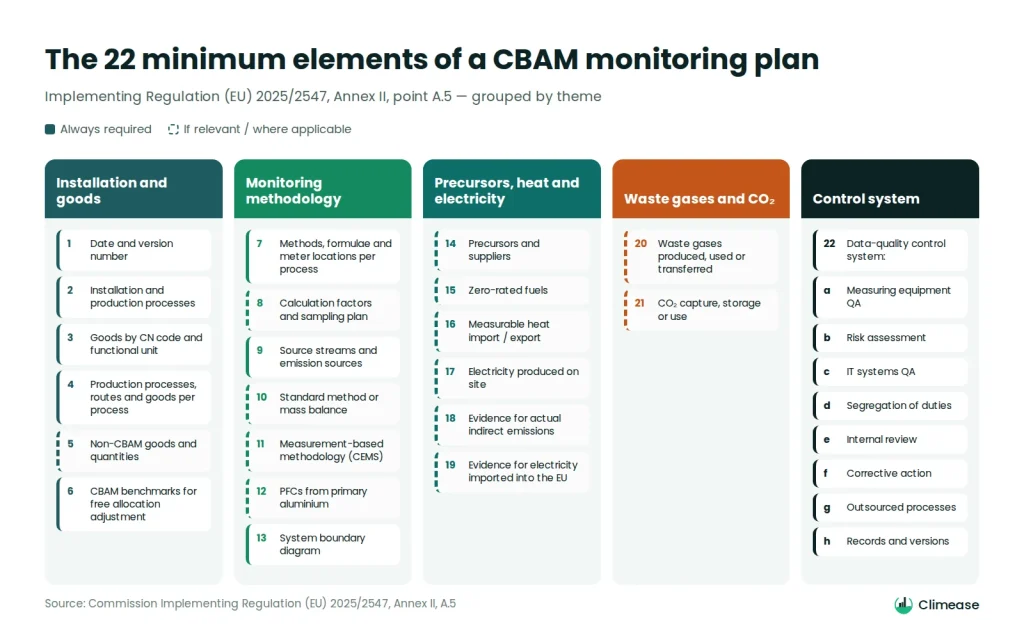
The 22 minimum elements in Annex II, point A.5
Annex II, point A.5 of Regulation (EU) 2025/2547 is a template with minimum content, not a form to fill in. Grouping the 22 elements helps teams see which ones apply to every installation and which depend on the site.
| Group | Minimum elements (A.5 numbering) | When it applies |
|---|---|---|
| Installation and goods | 1 Date and version number. 2 Description of the installation and processes. 3 Goods by CN code and functional unit, with clinker or nitrogen content where relevant. 4 Production processes and routes, and goods per process. 5 Non-CBAM goods and quantities. 6 CBAM benchmarks for the free allocation adjustment. | All; element 5 only if non-CBAM goods are produced |
| Monitoring methodology | 7 Methods per production process, with input data, formulae and exact meter locations. 8 Calculation factors and sampling plan. 9 Source streams and emission sources. 10 Standard method or mass balance parameters. 11 Measurement-based methodology (CEMS). 12 PFCs from primary aluminium. 13 Diagram and system boundaries showing no double counting or data gaps. | 7, 9 and 13 always; 8 and 10 for calculation-based methods; 11 for CEMS; 12 for primary aluminium |
| Precursors, heat and electricity | 14 Precursors per process and, if bought in, supplier name and country. 15 Zero-rated fuels and how zero-rating is demonstrated. 16 Measurable heat imported or exported. 17 Electricity produced on site. 18 Evidence for actual indirect emissions (point D.4.3). 19 Evidence for actual values of electricity imported into the EU (point D.2.4). | Where the situation exists at the installation |
| Waste gases and CO2 | 20 Waste gases produced, used, imported or exported. 21 CO2 capture, storage or use. | Mainly integrated steel and CCUS sites |
| Control system | 22 Data-quality control system with eight procedures (a) to (h). | All installations |
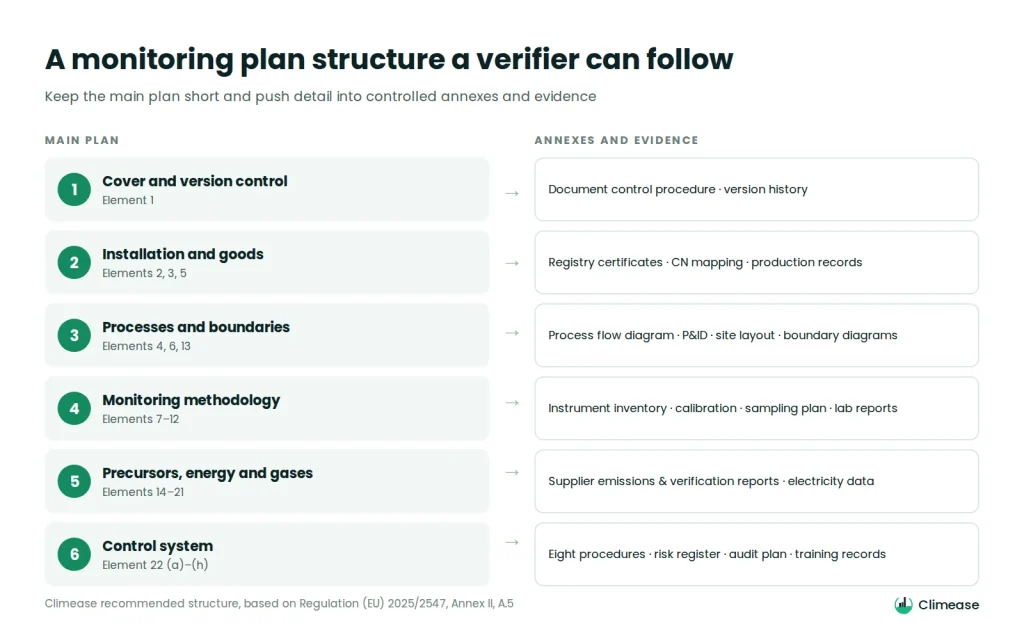
A document structure a verifier can follow
The regulation sets the minimum content, not the layout. A structure that keeps the main plan short and pushes detail into controlled annexes is easier to maintain and easier to verify. It should also stay consistent with the operator’s emissions report: Annex IV of the regulation requires that report to include a summary of the monitoring plan, including production processes, the five most important goods, fuels and process materials.
| Part of the plan | What it contains | Typical supporting evidence |
|---|---|---|
| 1. Cover and version control | Version number, date in force, approver, change log (element 1) | Document control procedure, version history form |
| 2. Installation and goods | Operator and site data, CN codes, functional units, non-CBAM goods (elements 2, 3, 5) | Registry certificates, product list, CN mapping checked against TARIC, 12 months of production records |
| 3. Processes and boundaries | Production processes, routes, benchmarks, boundary diagrams, material flows between processes (elements 4, 6, 13) | Process flow diagram, P&ID or metering diagram, site layout |
| 4. Monitoring methodology | Source streams, emission sources, method per stream, formulae, calculation factors, sampling (elements 7 to 12) | Instrument inventory, calibration certificates, uncertainty assessment, sampling plan, laboratory reports |
| 5. Precursors, energy and gases | Precursors and suppliers, electricity sources, heat, waste gases, zero-rated fuels, CCUS (elements 14 to 21) | Supplier emissions reports and verification reports, electricity invoices, sub-meter data, PPAs or certificates |
| 6. Control system | The eight procedures (a) to (h) and the data-flow description (element 22) | Written procedures, risk register, internal audit plan, corrective-action log, training records |
How to prepare a CBAM monitoring plan step by step
- Appoint an owner and set up version control. Name the plan owner and the approver, define the numbering (for example v1.0 for the first issue) and write a short document control procedure.
- Define the installation and its goods. Record the operator, site address in English, coordinates and UN/LOCODE. List every CBAM good by CN code with its functional unit: tonnes of goods, tonnes of clinker for cement, tonnes of nitrogen for fertilisers.
- Divide the installation into production processes. Goods with the same functional unit form one production process, even if several routes are used; their emissions are a weighted average across routes. For steel and aluminium goods that differ only in size or shape and use the same precursors, Annex II, point A.4 requires a single multifunctional process.
- Draw the system boundaries. Boundaries follow the aggregated goods category rules in Annex I. The diagram must show what is inside and outside each process, and how material, heat and waste-gas flows cross the boundaries, so a verifier can confirm there is no double counting and no data gap.
- List source streams and emission sources. Include every fuel and carbon-containing material, and every boiler, furnace, kiln or dryer. Emergency generators are easy to forget.
- Choose methods and data sources. For each stream, state whether the standard method, mass balance or a measurement-based method applies, and select the best available data source under point A.3. If you claim that a better method is technically not feasible or would cost too much, the justification must be in the plan. The regulation uses a reference price of €80 per tonne of CO2e for that test and treats improvements up to €4,000 a year as not unreasonable.
- Document measuring instruments. For each instrument, record its location, what it measures, its uncertainty, who owns it and its calibration frequency. Instruments under legal metrological control are preferred.
- Set calculation factors and sampling. Explain how the emission factor, net calorific value, oxidation factor, carbon content and biomass fraction are determined. Where you use laboratory analyses, include a sampling plan. Laboratories accredited to ISO/IEC 17025 are recommended; a non-accredited laboratory needs a justification.
- Map precursors and suppliers. List each precursor, its supplier and its country. Actual values for a bought-in precursor need that producer’s verification report; otherwise the default value applies. Actual and default values can be combined across different precursors.
- Cover electricity, heat, waste gases and CCUS. State whether each situation exists. Where actual values for indirect emissions are claimed, describe the evidence you will hold, such as smart-meter data and supplier emission factors.
- Write the control system. Draft or adapt the eight procedures described below and a data-flow diagram from the primary record to the reported figure.
- Run a pre-verification review, then freeze the version. Test the plan against a full month or year of real data before the verifier sees it.
The control system: eight procedures verifiers expect
Element 22 is where many first-time plans are weakest. Installations with ISO 9001 or ISO 14001 systems can usually adapt existing procedures rather than write new ones, but each must refer explicitly to CBAM data.
| Procedure | What it has to show | Typical evidence |
|---|---|---|
| (a) Measuring equipment QA | Instruments are calibrated, adjusted and checked at regular intervals and before use, traceable to international standards | Calibration schedule and certificates |
| (b) Risk assessment | Where errors can enter the data flow, from primary data to final figure | Risk and control register |
| (c) IT systems QA | Systems are designed, tested, controlled and maintained to process reliable data | Access rights, backups, change log |
| (d) Segregation of duties and competence | The person who records data is not the only one who checks it; staff are trained | Organisation chart, training records |
| (e) Internal review and validation | Data is checked for plausibility and reconciled with invoices and production records | Monthly review checklist |
| (f) Corrections and corrective action | Errors are corrected and root causes fixed | Non-conformity and corrective-action log |
| (g) Outsourced processes | Laboratories, calibration firms and consultants are controlled | Contracts, accreditation certificates |
| (h) Records and document versions | Documents are versioned and records kept for at least six years | Document control procedure, archive |
Who does what: a RACI for the monitoring plan
R = responsible, A = accountable, C = consulted, I = informed. Adapt the roles to the size of the site.
| Activity | Plant manager | Plan owner | Operations | Quality, lab, IT | Procurement |
|---|---|---|---|---|---|
| Approve the plan and changes | A | R | C | C | I |
| Draft and maintain the plan | I | A/R | C | C | C |
| Calibrate and maintain meters | I | A | R | C | – |
| Sampling and laboratory analysis | I | A | C | R | – |
| Monthly data collection and review | I | A | R | R | C |
| Precursor supplier data and reports | I | A | – | C | R |
| Prepare for and host the verifier | A | R | C | C | C |
The evidence pack
A verifier tests the plan against records. Collect these documents before the engagement starts and index them against the plan’s sections.
- Site layout, process flow diagram and metering or P&ID diagram.
- CN-code mapping and production records for the reporting period.
- Instrument inventory, calibration certificates and uncertainty assessment.
- Fuel and material invoices, stock records and weighbridge data.
- Sampling plan, laboratory contracts and analysis reports.
- System-boundary diagrams for each production process and a data-flow diagram.
- Precursor inventory, supplier list, supplier emissions reports and their verification reports.
- Electricity invoices, sub-meter data and, where used, PPAs or certificates.
- The eight control procedures, the risk register, the internal audit plan and corrective-action records.
- Organisation chart and training records for monitoring staff.
Pre-verification review: 10 checks before the verifier arrives
These checks mirror what a verifier typically looks at first. Climease’s emissions team includes former emission verifiers, so we run the same checks on a plan before the verifier sees it.
- Every CBAM good produced is listed by CN code and assigned to exactly one production process.
- The sum of emissions attributed to processes reconciles with installation-level emissions.
- Every source stream and emission source appears in the boundary diagram and in the calculations.
- Every meter in the calculation is in the instrument inventory with a valid calibration.
- Formulae in the plan match the spreadsheet or software used for the figures.
- Calculation factors have a documented source, date and, where analysed, a laboratory report.
- Each precursor has an actual value backed by a verification report, or is clearly marked as default.
- Data gaps have been filled with conservative estimates, and the method for doing so is documented.
- Every conditional element is either completed or marked “not applicable” with a reason.
- The version reviewed is the version in force, approved and dated.
Keep the plan current
Annex II requires monitoring to be consistent over time, so the methodology can only change when there is an objective reason: a change in equipment, technology, fuels, materials or goods; a new data source because a trading partner changes; or an opportunity to improve accuracy, simplify data flows or strengthen controls. Every change must be recorded.
Verification feeds the next version. If the verifier recommends improvements, the operator must consider them within a reasonable time unless they are technically not feasible or would incur unreasonable costs. Misstatements or non-conformities notified during verification must be corrected in the monitoring plan and the emissions report, and the final version given back to the verifier.
Frequently asked questions
Who has to prepare a CBAM monitoring plan?
The operator of each installation that produces CBAM goods and determines actual embedded emissions. EU importers do not prepare one themselves, but they depend on their suppliers’ plans for any actual values they declare. Without a complete monitoring plan, verification cannot start.
Does an authority have to approve the monitoring plan?
No approval step by a public authority is provided for. The plan is made available to the accredited verifier, who assesses the monitoring approach, calculations and evidence against it. If the monitoring plan is incomplete or incorrect, verification can be delayed or fail.
In which language must the plan be written?
Article 5(6) of Regulation (EU) 2025/2547 requires English. The Commission recommends also keeping a local-language version for site staff.
How many elements must a CBAM monitoring plan contain?
At least the 22 elements in Annex II, point A.5. Several are conditional, for example CEMS, PFCs from primary aluminium, measurable heat, waste gases and CCUS.
How long must monitoring records be kept?
At least six years after the reporting period, at the installation, including supporting documents.
Can an installation combine actual and default values?
Yes. Where a precursor lacks a verification report, its default value is used, while actual values can still be used for other precursors that have been verified and for the installation’s own emissions. It can be worth agreeing with the verifier in the contract that the final emissions value may be updated if verified precursor data becomes available after the verification is concluded.
When should the plan be ready?
Before the verifier starts work on 2026 data. The first verification reports can be issued from January 2027, and the first annual declaration for 2026 imports is due by 30 September 2027.
Get your monitoring plan ready for verification with Climease
Climease takes non-EU operators through each of the 22 elements with a structured question set, maps the documents required for each one, assembles the evidence pack a verifier will ask for and generates the final monitoring plan document. Our international emissions team, led by former emission verifiers who have reviewed this kind of documentation from the verifier’s side, then assesses every plan manually before it goes to the verifier.
EU importers use the same structure to see which suppliers are ready for actual values and which will stay on defaults.
Request a monitoring-plan readiness review or contact Climease to discuss your installations or suppliers.
This article provides general information and does not constitute legal, technical or verification advice. Operators should check the binding texts and the latest Commission guidance before finalising a monitoring plan.
Official sources
- Commission Implementing Regulation (EU) 2025/2547 — Article 5 and Annex II, point A.5 (monitoring plan template), points A.2 and A.3 (principles, data sources)
- Commission Implementing Regulation (EU) 2025/2546 — verification principles
- European Commission guidance documents for the definitive period (14 August 2026) — including Guidance No. 2 for non-EU operators
- European Commission guidance for CBAM verifiers and accreditation bodies (24 August 2026)
- European Commission CBAM verification — accreditation timeline and first verification reports
Subscribe to our Newsletter