


Every CBAM good you import in 2026 ends up in your declaration with one of two numbers attached: the Commission’s default value or your supplier’s actual, verified emissions. The choice drives your certificate bill, the work your team takes on and how well your declaration holds up under review.
Most importers treat it as a yes-or-no question for the whole company. It works better as a decision you make supplier by supplier, based on four things: data availability, verification, cost exposure and auditability.
Answer capsule
Importers may use Commission default values or actual emissions data. Actual data must be verified; defaults reduce data effort but may increase exposure. The best portfolio strategy is often to start with a defensible default baseline and prioritise verified data where the cost gap is largest.
The two methods in plain terms
Default values are emission intensities published by the Commission per CN code and country of origin, set out in Implementing Regulation (EU) 2025/2621 and corrected by Implementing Regulation (EU) 2026/1740 in July 2026. They are built to be conservative. In the definitive period they include a mark-up that rises each year: 10% for most goods in 2026, 20% in 2027 and 30% from 2028 (1% for fertilisers).
Actual emissions are the specific embedded emissions of the installation that made your goods, monitored under the CBAM methodology in Implementing Regulation (EU) 2025/2547. They reflect the plant’s real fuels, processes, electricity and precursors.
Who can use which
- Any importer can use defaults for any good. No supplier data is needed beyond the CN code and the country of origin.
- Actual emissions can be used only when they are verified. The installation must monitor emissions under the CBAM rules, and an accredited verifier must confirm them. The verified data reaches you through the CBAM Registry.
- You can mix methods. Different suppliers, different goods and even different precursors inside one good can use different methods. What you cannot do is mix methods within the same input, for example actual emissions with a default benchmark. Our CBAM benchmarks guide explains why.
The verification requirement
Verification is the gate between “the supplier sent us a number” and “we can declare that number”. Unverified supplier data, however good, cannot replace a default value in your declaration.
What verification means in practice in the definitive period:
- It is done at installation level, by a verifier accredited for CBAM by an EU or EEA national accreditation body.
- For the 2026 reporting period, each installation needs a physical site visit. From 2027, visits can be virtual or waived in low-risk cases, with a physical visit at least every two years.
- The verifier checks the monitoring approach, the calculations and the evidence, and issues a report that the declarant retrieves from the CBAM Registry.
- Accreditation started in 2026. The Commission expected the first accredited verifiers to register in September 2026, the first verification reports in January 2027, and the 2026 declarations to be finalised by 30 September 2027.
That timeline matters for the method choice. Verifier capacity is limited in this first cycle, so a supplier that starts the process in mid-2027 may not get a report in time. Our guide on preparing a CBAM monitoring plan for verification covers what installations need in place.
Cost and effort trade-offs
| Criterion | Default values | Verified actual emissions |
|---|---|---|
| Data needed from supplier | None beyond origin and CN code | Monitoring data per installation, production route, precursors |
| Verification | Not required | Required, by an accredited verifier, with site visit in 2026 |
| Cost exposure | Higher, and rising with the mark-up each year | Usually lower, reflecting real plant performance |
| Internal effort | Low | Moderate to high in year one, lower once the process runs |
| Auditability | High: published values, easy to evidence | High if the verification report is complete and on the registry |
| Timing risk | None | Depends on supplier readiness and verifier capacity |
| Best for | Small volumes, low-gap goods, unready suppliers | Large volumes, high-gap origins, cooperative suppliers |
The financial gap is not fixed. Two effects push it wider every year: the default mark-up rises from 10% to 30%, and the free allocation deduction shrinks as the CBAM factor falls from 97.5% in 2026 to 90% in 2028. The chart below uses the same illustrative hot-rolled steel case as our benchmarks guide, at a constant €75 per certificate.
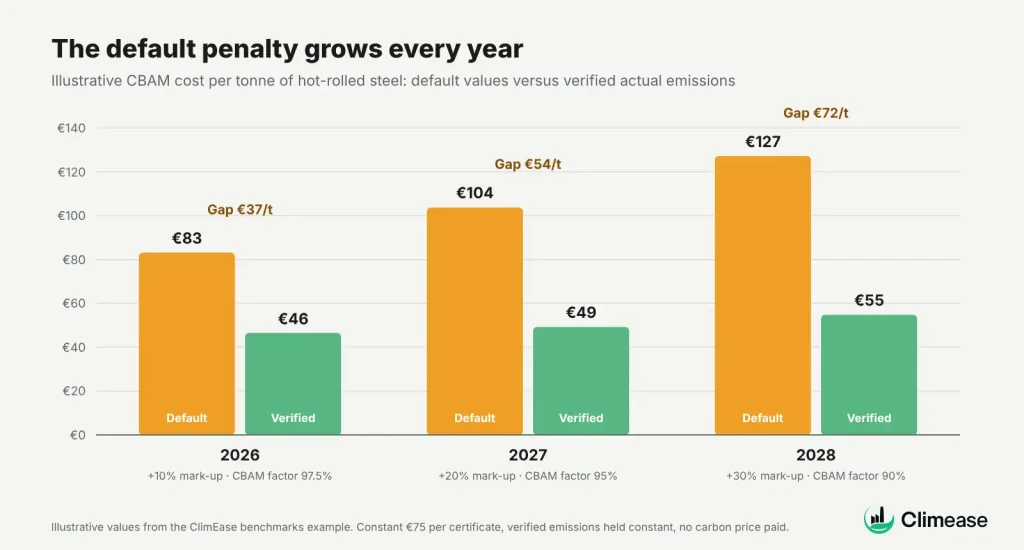
In this example the gap between default and verified grows from about €37 per tonne in 2026 to about €72 per tonne in 2028. On 10,000 tonnes a year, that is the difference between a supplier engagement budget and a line item finance will ask about. Your own gap depends on origin, product and the supplier’s real emissions, so model it per supplier rather than per portfolio.
A decision tree for each supplier
Run these questions for every supplier and CN code. The answer is not permanent: re-run it each year, because both the mark-up and supplier readiness change.
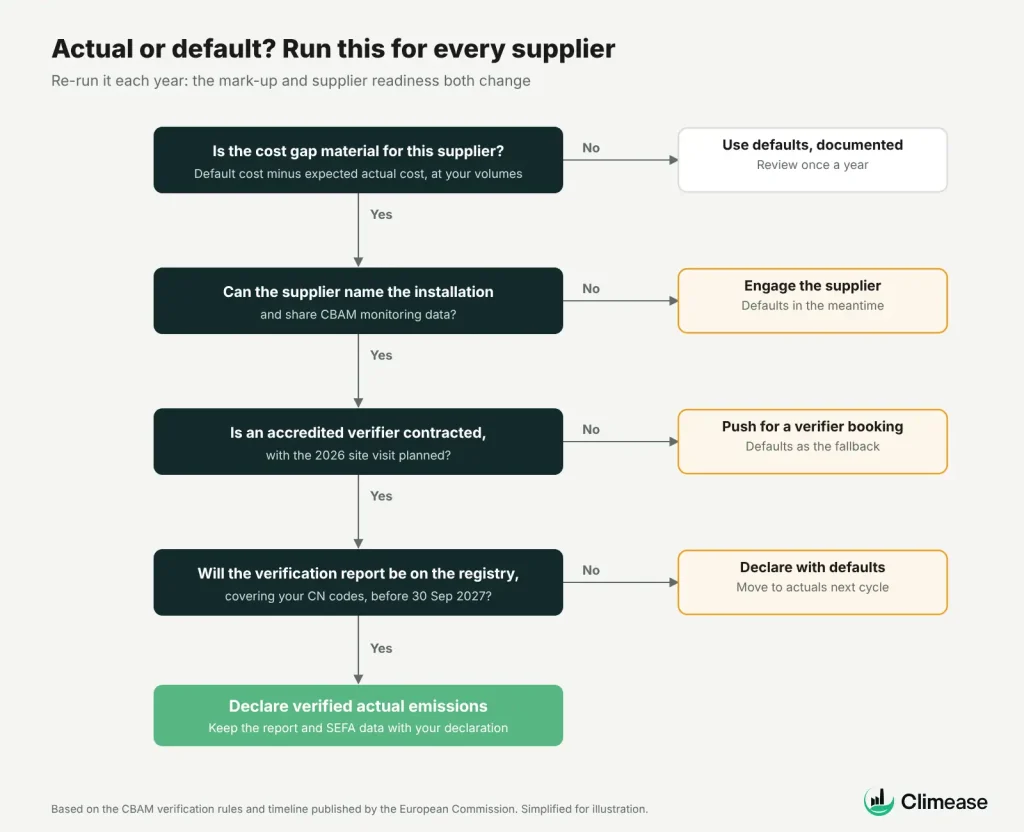
Two rules keep the tree honest. First, a “no” is not a failure: a documented default with the right CN code and origin is a compliant, defensible position. Second, the cost question comes before the effort question. If the gap is small, verified data is a nice-to-have; if it is large, it is worth real effort to get.
The portfolio approach
Most importers have dozens of suppliers. You will not get verified data from all of them in the first cycle, and you do not need to. Plot each supplier on two axes: the cost gap between default and actual for your volumes, and how ready the supplier is to provide verified data.
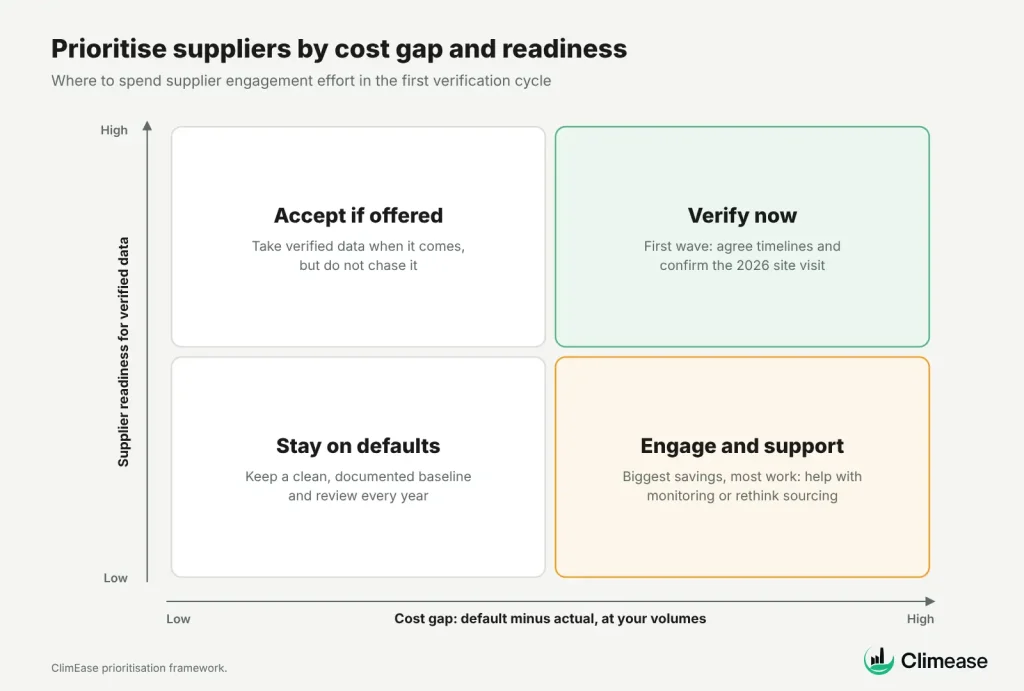
- Verify now (high gap, ready supplier): your first wave. Agree timelines and make sure the installation has a verifier booked for its 2026 site visit.
- Engage and support (high gap, supplier not ready): the biggest savings sit here, but they take work. Help the supplier with monitoring and data, or consider alternative suppliers for future contracts.
- Accept if offered (low gap, ready supplier): take verified data when it comes, but do not spend scarce effort chasing it.
- Stay on defaults (low gap, not ready): keep a clean default baseline and review annually.
Migrating from defaults to actuals
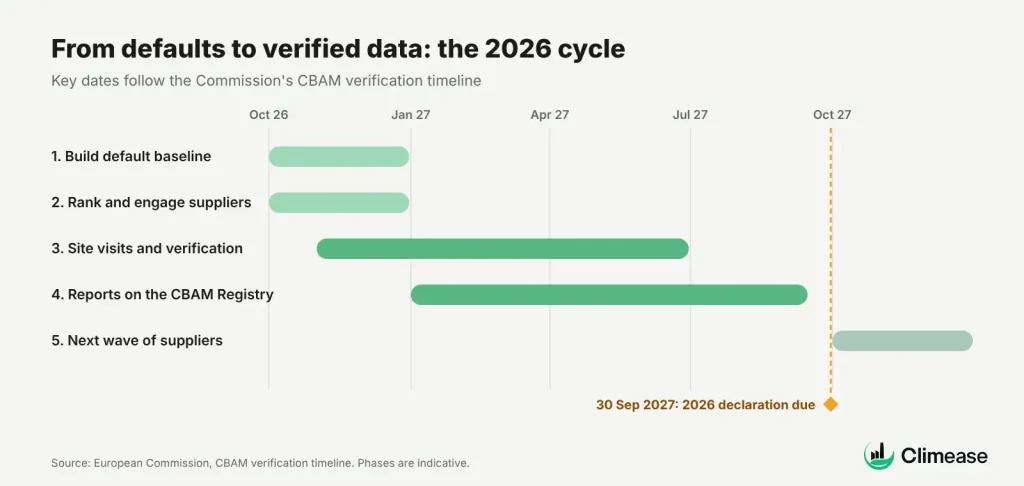
Moving a supplier from defaults to verified data is a project with a deadline. A practical sequence for the 2026 reporting year:
- Now to December 2026: build the default baseline. Map every CBAM import by CN code, origin, supplier and installation. Calculate the default cost so you know your worst case.
- Now to December 2026: rank and engage. Use the portfolio view to pick first-wave suppliers. Ask each one which installation made your goods, whether it monitors under CBAM rules, and whether a verifier is contracted.
- Q1 to Q2 2027: track verification. Follow site visits and report issuance. Check that the report covers your CN codes and the right installation, and includes the free allocation data you need.
- By 30 September 2027: declare. Use verified data where reports are on the registry and complete. Use defaults everywhere else, documented.
- From October 2027: widen the net. Move the next wave of suppliers across, now with a full year of experience.
Contracts help this move. New purchase orders and supply agreements can require CBAM monitoring, verification by an accredited verifier and data delivery deadlines, so the burden does not sit with your compliance team alone.
FAQs
Can I use supplier emissions data that has not been verified? No, not in the definitive period. Unverified data can guide your cost modelling and supplier ranking, but the declaration must use verified actual emissions or default values.
Can I use actual data for one supplier and defaults for another? Yes. The choice is made per good and per installation, and precursors inside one good can also use different methods, as long as each input is treated consistently.
Are default values always more expensive? Usually, but not always. Defaults are set conservatively and carry a mark-up, so most efficient plants beat them. A supplier with an emissions-intensive route can come out above the default, which is a reason to model before you commit.
What happens if verification is not finished by the declaration deadline? You declare that supplier’s goods with default values. Plan for this as your fallback rather than discovering it in September 2027.
Who pays for verification? The verifier is normally engaged by the installation operator, and the cost is part of the commercial discussion with your supplier. Some importers share the cost with high-volume suppliers because the certificate saving lands on the importer’s side.
Does using defaults create audit risk? Not if they are applied correctly. The common errors are a wrong CN code, a wrong country of origin and pairing default emissions with the wrong benchmark.
The bottom line
There is no single right method for an importer. There is a right method for each supplier, and it changes over time. Start from a clean default baseline, rank suppliers by cost gap and readiness, and move the high-gap, ready suppliers to verified data first. The rising mark-up means every year of delay costs more than the last.
Want to see where your gap is largest? ClimEase compares default and actual costs side by side for every supplier and CN code, and our team engages suppliers directly to get verified data. Book a 30-minute call and bring your supplier list.
Related reading: CBAM benchmarks 2026: default, calculated and mixed-data scenarios · Avoid EU default values and save on CBAM costs · CBAM emission calculation explained for suppliers
Sources: European Commission: CBAM verification · European Commission: CBAM legislation and guidance · European Commission: CBAM news
Subscribe to our Newsletter