


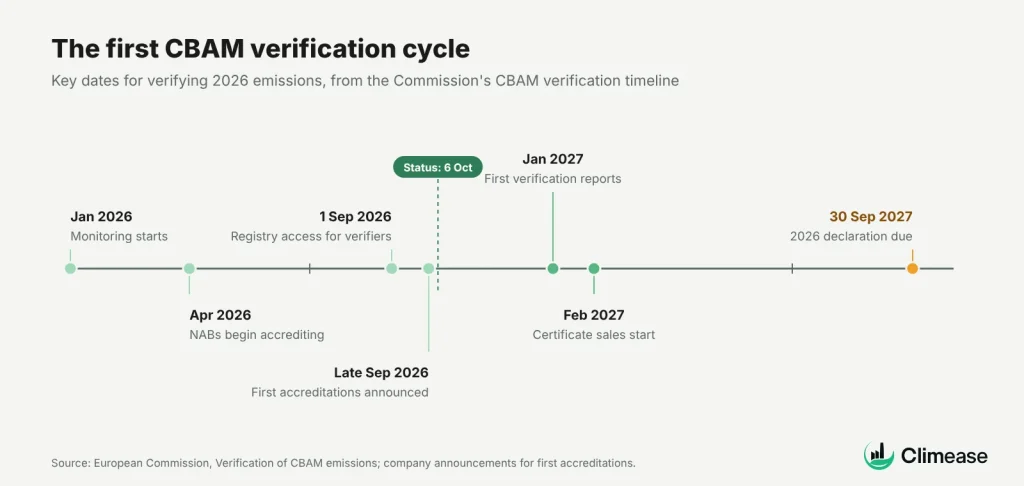
For most of 2026, the honest answer to “can our supplier get verified?” was “not yet, no verifier is accredited”. That has changed. National accreditation bodies started accrediting CBAM verifiers in 2026, the CBAM Registry opened its verifier access procedure on 1 September, and the first accreditations were announced in late September.
The question for importers is now practical: which of your suppliers will have a valid verification report on the registry in time for the 2026 declaration, due by 30 September 2027?
Answer capsule
Actual emissions used in a CBAM declaration must be verified by an independent verifier accredited by an EU national accreditation body. Verification applies at installation level. The first accreditations were expected around September 2026, so capacity and registration status now need checking against the live Commission list.
Status box: as of 6 October 2026
Check again on the day you read this.
- 24 national accreditation bodies in the EU and EEA have agreed to accredit CBAM verifiers. The Commission’s state-of-play table of 29 September 2026 shows most of them open for applications, with Romania and Slovakia expected to open in October and Slovenia in November.
- Official list of accredited verifiers: the Commission will publish it on its CBAM verification page. It was not yet published when we checked.
- First accreditations announced: EmiCert (accredited by ESYD, Greece, announced 23 September 2026) and Bureau Veritas (announced 29 September 2026). These are company announcements; confirm against the official list.
- CBAM Registry: the verifier access procedure applies from 1 September 2026. Accredited verifiers must register before they can submit reports.
Why verification matters
Verification decides which number goes into your declaration. If a supplier’s emissions are verified, you can declare them. If they are not, you use the Commission’s default values, which carry a mark-up of 10% in 2026, 20% in 2027 and 30% from 2028. Our actual versus default guide shows how that gap grows.
Verification also protects you. The declarant carries the liability for the declaration, and verification reports can be reviewed by the Commission and national competent authorities. A complete report from an accredited verifier is your evidence that the actual figures were checked to a defined standard.
Who can verify
Only a verifier accredited for CBAM by a national accreditation body (NAB) of an EU or EEA country can verify embedded emissions for the definitive period. The rules sit in Delegated Regulation (EU) 2025/2551 on accreditation and verification and Implementing Regulation (EU) 2025/2546 on verification principles.
- Verifiers established in the EU or EEA apply to the NAB of their own country, unless that NAB does not offer CBAM accreditation.
- Verifiers established outside the EU can apply to any NAB that offers the service. Location does not matter; the EU accreditation does.
- Scope matters. Accreditation is granted for specific activity groups. A verifier accredited for steel is not automatically accredited for aluminium, cement or fertilisers.
- Independence matters. The verifier must be independent of the installation it verifies, and impartial in its work.
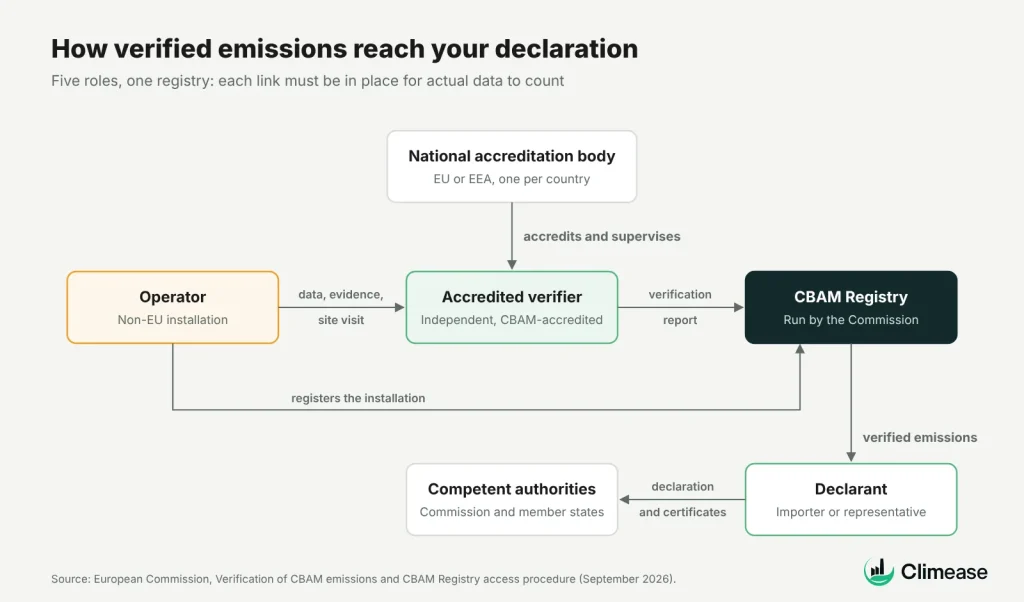
Who does what
| Role | Who | Main responsibility |
|---|---|---|
| Operator | The non-EU installation that produces the goods | Monitors and calculates emissions under the CBAM methodology, keeps the evidence, engages the verifier, registers in the CBAM Registry |
| Verifier | An independent body with CBAM accreditation | Assesses risk, visits the site, tests data and calculations, issues the verification report through the registry |
| National accreditation body | One per EU or EEA country | Accredits verifiers for defined activity groups and supervises them |
| Declarant | The authorised CBAM declarant, usually the importer or its representative | Retrieves verified emissions from the registry, uses them in the annual declaration, surrenders certificates |
| Commission and national competent authorities | EU and member state level | Run the registry, approve registrations, publish the verifier list and review declarations |
Installation scope and site work
Verification happens at installation level, not per importer or per shipment. One verification of an installation covers the CBAM goods it produced in the reporting period, and the verified data can serve every EU declarant who bought from it. That is good news for importers who share suppliers: one verification can cover many customers.
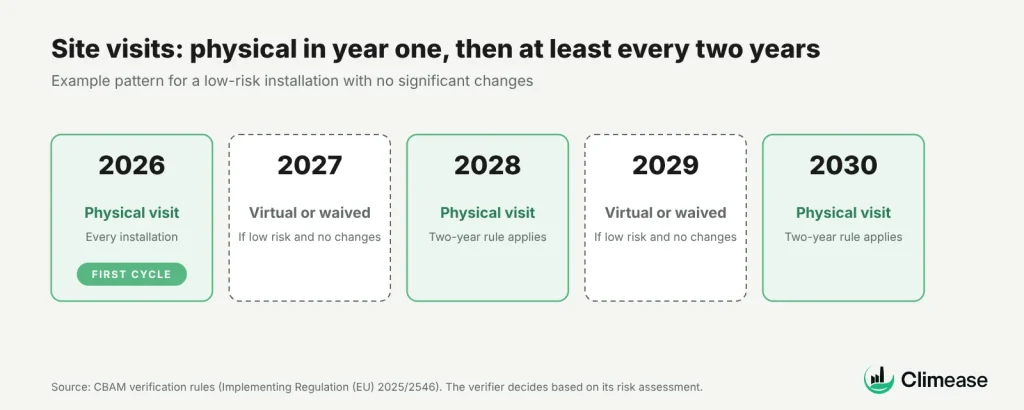
The site visit rules are strict in the first year:
- 2026 reporting period: a physical site visit to every installation producing CBAM goods.
- From 2027: the verifier may replace the physical visit with a virtual one, or waive it, where the risk is low and nothing significant has changed. A physical visit is still required at least once every two years.
On site, the verifier walks through how data is produced: meters and their calibration, fuel and material records, production records by CN code, precursor inputs, electricity consumption and the boundaries of each production process. Staff interviews are part of the visit. The verifier then tests the calculation against the evidence. Misstatements above a 5% materiality level prevent a positive opinion until they are corrected.
The evidence and the verification report
A smooth verification depends on what the operator has ready. The core evidence set:
- The monitoring methodology documentation for the installation, describing system boundaries, production processes and data sources
- Fuel, material and electricity data with invoices, meter readings and calibration records
- Production quantities by CN code
- Precursor quantities, their origin and their embedded emissions, including supplier reports for purchased precursors
- The emissions calculation, including the specific embedded free allocation data used for the benchmark deduction
- Records of any data gaps and how they were filled
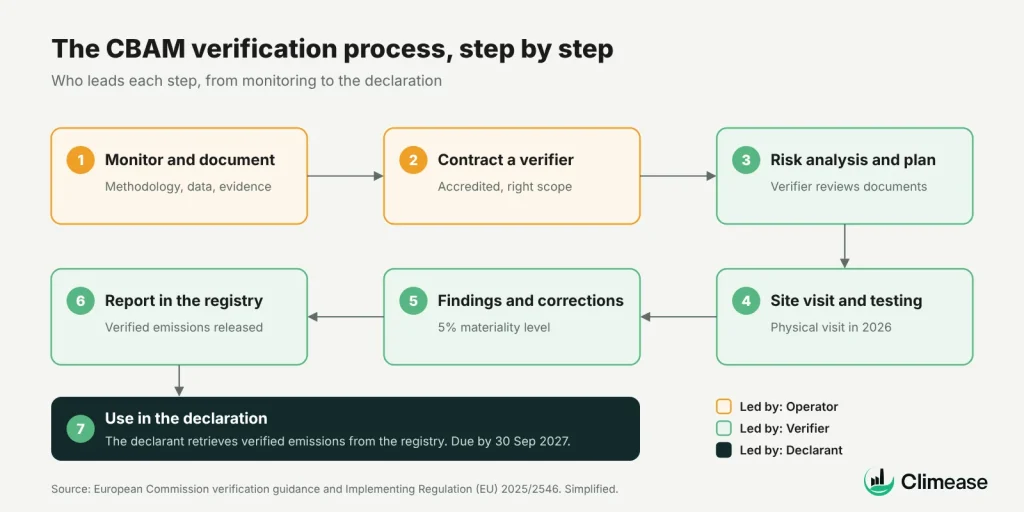
The verification report records, among other things, the verifier’s accreditation details, the installation identity, the reporting period, direct and indirect emissions, precursors, production by CN code, specific embedded emissions and the verifier’s opinion. It is submitted through the CBAM Registry, where the declarant retrieves it.
What counts as verified, and what does not
| Counts | Does not count on its own |
|---|---|
| A verification report from a CBAM-accredited verifier, within its accredited scope, for the right installation and reporting period, available through the CBAM Registry | Supplier emission reports from the transitional period |
| EU ETS or national ETS verification reports | |
| ISO 14064 assurance statements, EPDs or product carbon footprints | |
| Reports from verifiers not accredited for CBAM, or outside their accredited activity groups | |
| Spreadsheets and supplier declarations without a verification report |
These other documents are still useful as input. A good EPD or ETS report often makes the CBAM verification faster. But they do not replace it.
Registry registration
The CBAM Registry is where verification becomes usable. Three registrations need to be in place:
- The verifier registers in the registry after accreditation, under the access procedure that applies from 1 September 2026. National competent authorities review the requests.
- The operator registers its installation, so it can collaborate with the verifier and share verified data.
- The declarant must be authorised, and retrieves the operator’s verified emissions for its declaration.
If any of the three is missing, the verified data cannot reach your declaration, however good the underlying work. Ask suppliers early whether their installation is registered and which verifier is linked to it.
Importer checklist
Use this for every supplier you want to move to actual emissions for the 2026 reporting year.
- ☐ We know which installation produced our goods, with its name, address and CN codes.
- ☐ The installation monitors emissions under the CBAM methodology for 2026.
- ☐ A verifier is contracted, and appears on the Commission’s official list of accredited CBAM verifiers.
- ☐ The verifier’s accredited scope covers the installation’s sector and goods.
- ☐ The 2026 physical site visit is scheduled, with a date.
- ☐ The installation is registered in the CBAM Registry and linked to the verifier.
- ☐ The report will include production by CN code, precursors and free allocation data.
- ☐ The expected report date leaves time before 30 September 2027.
- ☐ A default-value fallback is calculated in case verification slips.
- ☐ The contract with the supplier covers data delivery, verification and timelines.
The bottom line
Verification is no longer a future problem. Accreditation is under way, the registry is open to verifiers and site visits for 2026 data are starting. Capacity will be tight in this first cycle, and every installation needs a physical visit. The importers who lock in their suppliers’ verification plans this quarter will declare actual emissions in 2027; the rest will pay the default mark-up.
Want help getting suppliers verification-ready? ClimEase’s team of former verifiers works with your suppliers on monitoring, evidence and verifier readiness, and tracks verification status for every installation in your portfolio. Book a 30-minute call and bring your top suppliers.
Related reading: Actual vs default emissions under CBAM · CBAM benchmarks 2026 · CBAM emission calculation explained for suppliers
Sources: European Commission: Verification of CBAM emissions · European Commission: CBAM legislation and guidance · European Commission: CBAM news
Subscribe to our Newsletter